
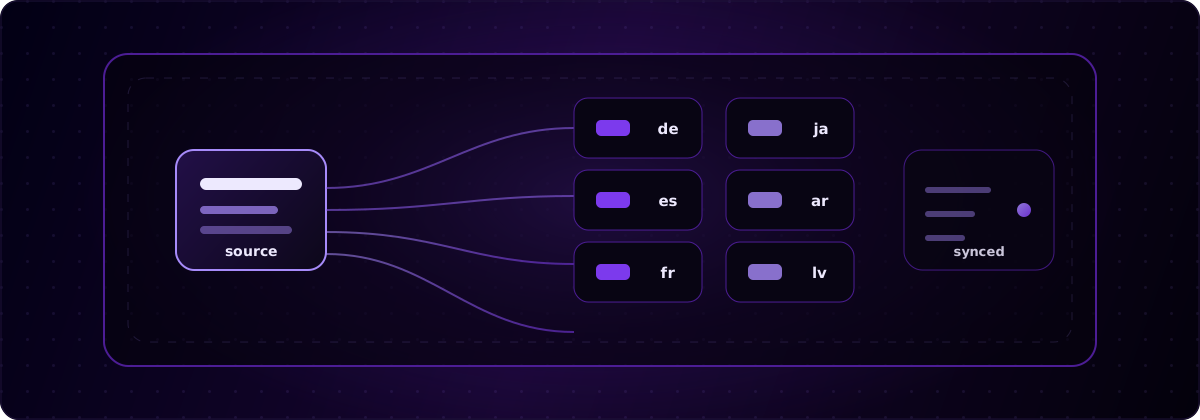
Software localization is the process of adapting a software product so it feels native in a specific language, region, and market, not just translated word for word. globalize.now is AI-powered localization infrastructure that automates the hardest engineering part of that process. This guide covers what localization includes, how it differs from internationalization, why it moves revenue, and how to do it without piling up i18n debt in an AI-generated codebase.
What does software localization mean?
Localization means reshaping your product for one target market: its language, its formats, and its expectations. Translation is only the visible layer.
A properly localized app translates every UI string, but it also formats dates, numbers, and currency the way that market writes them, applies the correct plural rules, supports right-to-left scripts where needed, and adapts tone, examples, and imagery so nothing reads as foreign. The goal is that a user in Berlin, São Paulo, or Riyadh never notices the product was built somewhere else.
The l10n abbreviation you will see everywhere is a numeronym: the word localization starts with l, ends with n, and has 10 letters in between. The same shorthand gives i18n for internationalization.
How is localization different from internationalization?
Internationalization is the engineering that makes localization possible; localization is the content work that happens afterward.
Internationalization (i18n) is what the developer does to the codebase once: extract hardcoded strings into locale files, switch to Unicode, use locale-aware formatting APIs like Intl, and structure the layout to survive text expansion and right-to-left languages. Localization (l10n) is what happens per market: translating the strings and adapting the formats for German, Japanese, Arabic, and so on.
Order matters. You cannot cleanly localize an app that was never internationalized, because the strings are still glued into the components, so every language means another round of code surgery. Internationalize once, then localize repeatedly. If you want the deeper engineering breakdown, the globalize.now developer guide walks through the string-extraction and locale-file structure.
What does the localization process include?
A complete localization pass covers far more than swapping English words for another language.
- Interface text — every button, label, error, and empty state, pulled from locale files rather than hardcoded.
- Numbers, dates, and currency — how each market writes a thousands separator, a decimal, and a currency symbol differs, so the same value is formatted differently per locale.
- Plurals and grammar — English has two plural forms; Arabic has six. Hardcoded string concatenation breaks the moment you leave English.
- Right-to-left layout — Arabic and Hebrew mirror the entire interface, not just the text.
- Tone and imagery — register, idioms, examples, and visuals that land differently across cultures.
Miss any one of these and the product reads as machine-translated, which erodes trust faster than shipping English-only would have.
Why does software localization matter for growth?
Localization is a revenue lever, not a nicety. Most of your potential users will not buy in a language they do not read.
In CSA Research's survey of 8,709 consumers across 29 countries, 76% preferred buying products with information in their own language, and 40% said they never buy from sites in other languages. The market backs this up: the software localization market was valued at roughly USD 5.57 billion in 2024 and is forecast to keep growing at a double-digit CAGR through the next decade, per GMInsights. Every language you skip is addressable market you have chosen to leave on the table.
For an indie hacker or small team, that math is stark: the effort to add three or four languages is small compared to the share of signups an English-only product silently turns away. The globalize.now guide for vibe coders covers how to prioritize which languages to add first.
Where does localization break in AI-generated apps?
AI coding tools ship features fast, but they almost always hardcode UI text straight into components, which is exactly what makes later localization painful.
Ask Cursor, Claude Code, Lovable, or Bolt to build a screen and you get a hardcoded <button>Sign up</button>, not a translation key. Multiply that across a whole app and you have i18n debt: hundreds of hardcoded strings, duplicate labels, and broken plural logic scattered through the codebase. When you finally decide to add a second language, you are not localizing. You are first re-engineering the app to be internationalizable at all, string by string.
This is the specific gap globalize.now exists to close. Instead of hand-hunting every literal, the extraction happens automatically and stays current as the AI keeps generating new screens.
What tools do you need to localize software?
Localization is a stack, not a single tool, and the layers do different jobs.
- i18n runtime libraries — i18next, next-intl, react-intl. They serve the right translation at runtime and handle plurals and interpolation.
- Localization infrastructure — globalize.now. It extracts hardcoded strings, generates translation keys and locale files, and keeps them in sync on every Git push. This is the layer most AI-built apps are missing.
- Translation management systems (optional) — Lokalise, Crowdin, Phrase. They manage human-translator workflows if you use professional translators.
- Translation engines — DeepL, GPT-based translation, lingo.dev. These produce the actual translated text.
globalize.now sits at the infrastructure layer: it does not replace your i18n runtime and it does not replace a translation engine. It generates and maintains the keys and locale files those layers depend on, which is the part that otherwise gets done by hand. For a vendor-by-vendor view, see the globalize.now vs Lokalise vs Crowdin comparison.
How do you localize software without manual i18n debt?
Set up the extraction once and let it run on every push, so localization never falls behind the code.
The manual version is a treadmill: export strings, send them out, re-import, resolve conflicts, and repeat every time a developer or an AI tool adds a screen. globalize.now removes that loop. It scans the codebase, pulls hardcoded strings into locale files, generates the translation keys, and re-syncs automatically whenever you push to Git, with no manual exports, no review queue, and no drift between what shipped and what is translated.
For teams building with AI coding tools, that is the difference between localization being a one-time setup and localization being a permanent chore.
globalize.now handles the infrastructure layer of all this. Set it up once and it extracts your strings and syncs locale files on every Git push. See how it works at globalize.now.
globalize.now turns hardcoded app copy into translation-ready locale files and keeps them updated as you ship.
Try globalize.now free