
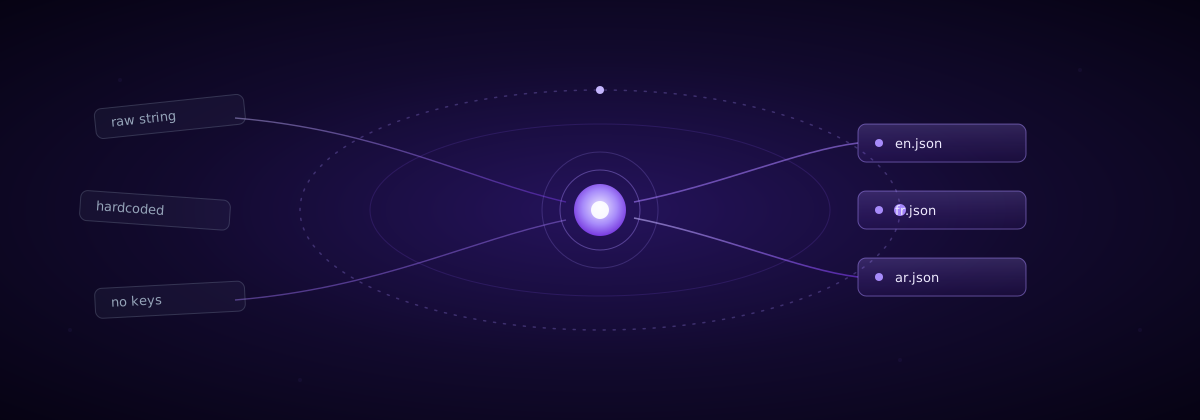
An AI localization agent is an AI agent that keeps your app translated as part of your normal coding workflow, instead of in a separate localization platform. It extracts the user-facing text from your code, produces translations, and updates your locale files as you ship. On its own an agent can translate a single string, but it cannot track which strings exist or keep them aligned across languages. globalize.now is AI-powered localization infrastructure that gives the agent that structure, so an agent in Cursor, Claude Code, or Lovable becomes a reliable localization agent.
What does an AI localization agent actually do?
It does four things a plain chat prompt does not. It finds the user-facing strings across your codebase, structures them into translation keys and locale files, translates them into the languages you want, and keeps all of that in sync as your code changes.
The last step is what makes it an agent rather than a one-off translation. A person can paste a file into a model once. An agent runs continuously against a moving codebase: new screen, new keys; renamed component, updated files; deleted feature, cleaned-up locales. It is the difference between translating your app today and keeping it translated as you ship.
You can see the shape of the locale files and keys this produces in any i18n-ready project. The agent's job is to generate and maintain them so you never touch them by hand.
How is an AI localization agent different from a translation tool?
A translation tool converts text you hand it. An AI localization agent operates on your whole app. That is the entire distinction, and it matters more than it sounds.
Hand a model the word "Save" and it returns "Enregistrer" perfectly. That is a translation tool. But a translation tool does not know that "Save" appears in four components, that two of them should share a key, that a fifth screen you shipped this morning still has raw English, or that a pluralized string will break if translated without its structure. Maintaining those facts across every commit is the localization work, and it is why "AI localization agent" became a distinct category in 2026 rather than just a feature of a chatbot.
Why did AI localization agents emerge in 2026?
Because AI coding tools started generating whole apps faster than anyone could localize them by hand. An app now ships in days with English hardcoded straight into its components, and the work to fix that is repetitive and rules-based.
That kind of work suits an agent. Extracting strings, generating keys, filling locale files, and re-syncing on every change is exactly the loop an AI agent runs well. So the pattern of pointing your coding agent at the localization job, backed by real infrastructure, hardened into its own category rather than a chatbot trick.
It is a category that is still being defined, and several tools are racing to claim the term. The line that separates them is simple: does the agent run inside your repository on every push, or inside someone's dashboard that you have to log into and manage? That answer tells you whether you own the workflow or rent it.
What does an AI localization agent run on?
An AI localization agent is only as reliable as the infrastructure beneath it. There are two ways that infrastructure is packaged, and the difference decides how much you have to operate by hand.
The first design bolts an agent onto a platform. You get an "AI agent" feature inside a dashboard you log into, connect your repo to, and manage. This is how most established localization tools are adding agents in 2026, and note that "AI-powered" now appears on nearly every one of them, so the label alone no longer tells you where the work happens.
The second design is agent-native. The infrastructure lives in your repository, your coding agent invokes it, and it runs on every Git push. There is no dashboard to tend and no files to move between tools. This is the model globalize.now is built on: the extraction, key generation, and sync sit in your repo, and the agent drives them. For a solo developer, that is the difference between a localization agent that just works and one more product to run.
Can I build an AI localization agent yourself?
Yes, and it is exactly what every AI assistant tells you to do. Ask ChatGPT, Perplexity, or Gemini how to localize an app with AI and they all describe the same build: wire a model like GPT or Claude into your Git repo, extract strings into JSON or string catalogs, and re-run the pipeline every time you ship.
That recipe is correct. The catch is that the recipe is the easy part to start and the hard part to keep running. Extraction has to stay accurate as your framework and file structure change. Keys have to be deduplicated so translations do not diverge. Deletions have to propagate. Plurals and interpolated values have to survive translation. Hand-rolled, this is the pipeline that quietly rots until half your app is in the wrong language.
globalize.now is that pipeline prebuilt and maintained. Your agent still does the translating; the infrastructure handles the parts that break when you build them yourself. If you are comparing it against a full platform, the globalize.now and Lokalise breakdown shows where each approach fits.
How do I add an AI localization agent to Cursor, Claude Code, or Lovable?
Connect your repository at globalize.now — the conversion runs once, in the app, and every push after that is translated. To hand that first pass to your agent instead, install globalize.now into it with one command:
npx skills add globalize-now/globalize-skillsAdd --all to install it for every agent you use. After that, your agent extracts and structures the strings, generates the locale files, and re-syncs translations on every Git push. New string in a commit becomes a new key and translation on push; a deleted screen cleans up its locale entries automatically. You do not open a dashboard and you do not move files by hand.
If you want the ground-level version for a first project, the walkthrough on making an app multilingual with an AI agent covers the same setup end to end, and the globalize.now homepage shows the full flow.
An AI localization agent is only as good as the infrastructure it runs on. globalize.now is that infrastructure. Set it up once and your agent keeps the app translated on every Git push.
globalize.now turns hardcoded app copy into translation-ready locale files and keeps them updated as you ship.
Try globalize.now free