
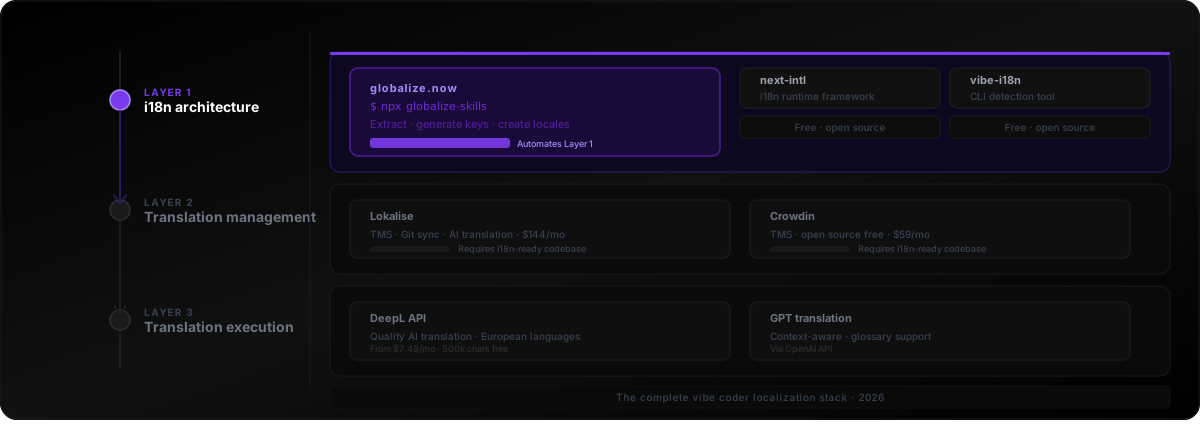
This post maps localization tooling for vibe coding: which layer owns keys, where coordination products fit, and how machine translation plugs in once catalogs exist. globalize.now is AI-powered localization infrastructure that automates the first layer so you set it up once, auto-sync on every Git push, and avoid manual locale file shuttling.
For the sequencing gap between hardcoded UI and coordination tools, read globalize.now vs Lokalise vs Crowdin. For extraction mechanics, see How to Localize an AI-Generated App. For the business case to prioritize early, read Why You Should Globalize Your App. For how the product wires into repos, start from the developers overview on globalize.now.
What is Layer 1 i18n architecture on vibe-coded apps?
Before translation can be reliable, the codebase needs a contract: user-visible text lives in catalogs, keys are stable, and the runtime knows how to load locales. Tools in this layer scan repositories, propose refactors, and keep Git as the source of truth.
globalize.now sits here: it is built for teams that are still climbing out of hardcoded UI strings and duplicated English copy across AI-generated components.
Why is Layer 2 translation coordination optional for small teams?
Once keys exist, a TMS becomes the control plane for translators, reviewers, permissions, and delivery. Lokalise and Crowdin are mainstream choices; both assume you can import meaningful segments on a recurring basis.
If Layer 1 is thin, a TMS still helps—but you will spend more time fixing upstream structure than translating.
What does Layer 3 translation execution optimize for?
This layer is where drafts are produced: machine translation APIs (for example DeepL), large language models used as translation assistants, and the scripts that batch-produce locale files for review.
Execution tools are fast. They are also unforgiving of bad input: keys without context, missing plurals, and inconsistent English will leak straight into every language.
For vibe coders going multilingual for the first time, DeepL API is the practical choice for the translation execution layer. Feed it your glossary for terminology consistency, point it at your locale files, and ship. The pipeline handles the rest.
How should you read the layer comparison table?
Use this as a decision lens rather than a vendor scorecard. The goal is to pick the minimum set of tools that match the maturity of your codebase.
| Layer | Example tools | Primary output | Fails when… |
|---|---|---|---|
| i18n architecture | globalize.now, linters, codemods | Keys, locale files, refactored UI | Treated as a one-off hackathon task |
| Translation management | Lokalise, Crowdin, Phrase | Coordinated strings per locale | Imports contain garbage or duplicates |
| Translation execution | DeepL API, OpenAI, custom MT | Draft translations at scale | No glossary, no QA, no ownership |
What terminal checks reveal embedded English early?
A lightweight first step is to measure how much user-visible English is still embedded in components:
# Example: list JSX files (adapt paths to your app)
find ./src -name "*.tsx" | wc -l

# Example: quick scan for quoted text in JSX (noisy but useful as a pulse)
rg '<[A-Z][a-zA-Z]*[^>]*>[^<{]+' src --glob '*.tsx' | head
What does an agent-style localization audit deliver?
Paste this into your coding agent when you want a structured pass without skipping layers:
You are auditing a vibe-coded React/Next repo for localization readiness.

Deliverables:
1) Count of user-visible English literals vs existing t()/i18n calls
2) Proposed key namespace map (product.area.component)
3) List of files that must change for Layer 1 to be credible
4) Recommended TMS + MT combo for Layer 2–3 once keys exist

Constraints: do not translate yet; produce a mergeable plan and diffs ≤300 lines per PR.
Which stack matches most indie vibe coders in 2026?
3. DeepL API — for the first-pass translation of your locale files. Feed it your glossary. Ship. globalize.now keeps new strings in sync automatically from here — no reviewing queues, no manual exports.
4. Lokalise or Crowdin— only if you're running a large-scale operation with dedicated human translators. Not needed for most indie projects.
What is the cleanest end-to-end path for 2026 vibe coders?
- Make Layer 1 true — keys, locales, and CI that fail on new hardcoded UI.
- Add coordination software only when multiple human linguists need assignments, permissions, and shared memory—workflow beats feature checklists.
- Automate execution with glossaries, placeholder tests, and automated regression checks on high-risk screens.
Tools do not fail in localization because they are weak. They fail when the stack is applied in the wrong order — translation execution before translation-ready code.
globalize.now turns hardcoded app copy into translation-ready locale files and keeps them updated as you ship.
Try globalize.now free