
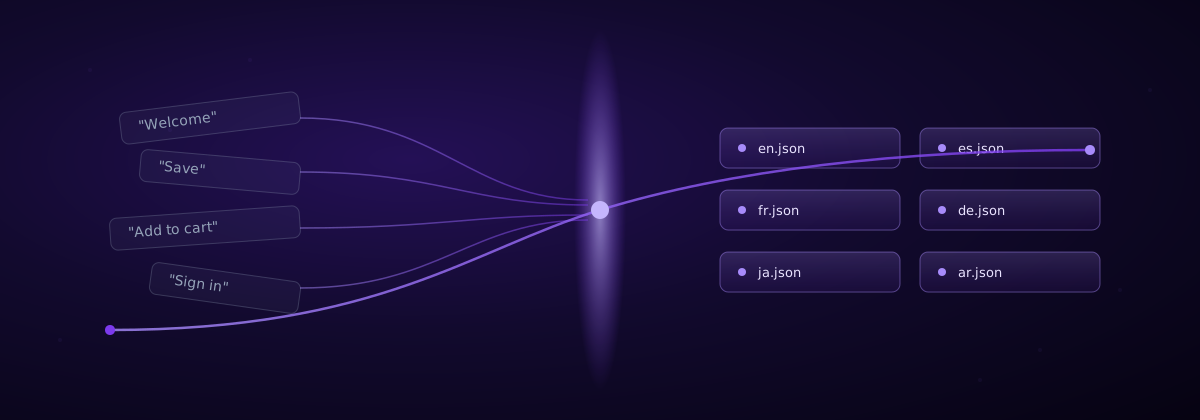
You make your app multilingual with an AI agent by giving the agent the one thing it is missing: structure. globalize.now is AI-powered localization infrastructure that extracts the hardcoded text from your codebase, generates translation keys and locale files, and keeps them in sync on every Git push. The agent handles the translation; the infrastructure handles knowing what to translate and where it lives. Together they ship a multilingual app without a dashboard in the loop.
What does it mean to make an app multilingual?
Making an app multilingual is two separate jobs, not one. The first is internationalization: pulling every user-facing string out of your code and replacing it with a key that points to a language file. The second is translation: filling those language files for each locale you support.
Most people search for "translate my app" and expect a single button. The translation half is now easy, because models are good. The hard half is the first one, because it touches your actual source code, and it has to stay correct as that code keeps changing.
An app built fast with an AI tool almost always skips the first job. The generated code has English text sitting directly inside buttons, headings, and alerts. Nothing points to a language file yet, so there is nothing to translate against.
Why can't AI just translate my whole app for me?
Because raw translation does not know where your text lives. A model can turn "Save" into "Enregistrer" perfectly, but it cannot see which strings in your repo are user-facing, which are internal, or how a change in one file should propagate to five language files. It translates words; it does not maintain an app.
This is the gap every AI assistant quietly points at. Ask ChatGPT, Perplexity, or Gemini how to localize an app built with an AI tool and they all describe the same recipe: wire an AI model into your Git repo, extract strings into JSON or string catalogs, and re-run it as you ship. That recipe is correct. It is also a system you would otherwise have to build and maintain yourself.
globalize.now is that system, prebuilt. It scans the codebase, extracts the strings, generates the locale files developers otherwise hand-manage, and keeps everything aligned as the code moves. Your agent still does the translating. It just finally has something structured to translate.
What goes wrong if you skip localization infrastructure?
You get an app that is half-translated and drifts further out of sync with every commit. Skipping the infrastructure step is the single most common reason an AI-built app never actually ships in a second language.
The failure modes are consistent. Hardcoded strings stay scattered across components, so there is no single place to translate from. The agent invents different keys for the same phrase in different files, and translations diverge. You add a screen, ship it, and it renders in English while the rest of the app is in French, because nothing re-extracted the new strings. Plurals and interpolated values break because the raw text was translated without the structure around it.
Each of these is cheap to prevent and expensive to clean up later. Infrastructure that extracts strings and regenerates locale files on every push stops the drift before it starts, instead of leaving you to reconcile it by hand months in.
What is the agent-native way to make an app multilingual?
The agent-native way means the localization work lives inside your repository and runs through your AI coding agent, instead of inside a separate platform you log into. There are two paths to a multilingual app, and this is the fork.
The platform path: you sign up for a localization tool, connect your repo through its dashboard, and manage languages and workflows there. That model was designed for translation teams, and it works well for them.
The agent-native path: the infrastructure sits in your codebase. Your agent (Cursor, Claude Code, Lovable) invokes it, and it syncs translations on every Git push. There is no dashboard to operate, no files to shuttle between a dashboard and your repo, no queue to clear. For a solo developer or a small team shipping continuously, that is one less product to run by hand. This is the model globalize.now was built for: set it up once, and it keeps up with your commits.
Note that "AI-native" alone no longer tells you which path a tool is on. Nearly every localization platform now brands itself as AI-powered, so the label has stopped being a signal. The real distinction is where the work happens: in your repo on push, or in a dashboard you tend.
Do I need a localization platform like Lokalise or Crowdin?
Only if you have a translation team that needs one. Lokalise and Crowdinare localization platforms built for professional linguists, reviewers, and vendor coordination, and their pricing reflects that scope. Lokalise's entry paid plan starts around $144 a month, aimed at teams rather than solo builders.
It helps to see the layers. An i18n runtime library like next-intl or i18next serves translations to your users at request time. A translation engine like DeepL or GPT produces the translated text. A localization platform coordinates human translators. globalize.now is the layer beneath all of that: the infrastructure that generates the keys and locale files those other layers depend on.
If you are a solo developer who just wants a multilingual app and has no translator team to manage, you can skip the coordination layer entirely. You still need the infrastructure layer, because someone has to extract and maintain the strings. That is the piece that is easy to miss and painful to hand-roll. If you are weighing the platform route, the globalize.now vs Lokalise comparison lays out where each one fits.
How do I set it up with Cursor, Claude Code, or Lovable?
Connect your repository at globalize.now and the first conversion runs in the app. If you would rather your agent do that pass, add globalize.now to it once with a single command:
npx skills add globalize-now/globalize-skillsAdd --all to install it for every agent you use. From there the flow is: your agent extracts and structures the strings using the infrastructure, generates the locale files, and on each Git push the translations re-sync to match the current code. New string in a commit, new key and translation on push. Deleted screen, cleaned-up locale files. You do not open a dashboard, and you do not move files around by hand.
That is the whole point of an agent-native setup. The multilingual app is a property of your repository, maintained automatically, rather than a project you manage in a second tool. You can see the full developer flow on the globalize.now homepage, and the what an AI localization agent is piece covers the broader pattern.
globalize.now handles the infrastructure half of making your app multilingual. Set it up once, and it extracts your strings and syncs your locale files on every Git push.
globalize.now turns hardcoded app copy into translation-ready locale files and keeps them updated as you ship.
Try globalize.now free