
This article argues why multilingual shipping belongs earlier in the roadmap: demand data, ROI benchmarks, compounding engineering risk, and what changed once vibe-coded repos shipped faster than their catalogs. globalize.now is AI-powered localization infrastructure that automates extraction, keys, locale files, and continuous sync on every Git push so small teams are not stuck in manual file workflows. For the five-prompt setup path, read How to Globalize Your App with globalize.now; for extraction detail, see How to Localize an AI-Generated App; for stack ordering, see Best Localization Tools for Vibe Coding in 2026; for AI-first gaps, read AI Code Broke Localization — And Nobody Fixed It.
Most apps still launch English-first because it is the path of least resistance—then hardcoded strings accumulate until the refactor costs more than the original build.
Is global demand already punishing English-only apps?
English reaches roughly 19% of the world's online population. Yet 49.4% of websites are written only in English. That gap is not an opportunity waiting to be discovered — it's one already being lost.
The purchasing behavior data is blunt:
- 72.4% of consumers are more likely to buy a product when information is available in their own language
- 60% of shoppers rarely or never buy from English-only websites
- 40% of consumers won't buy from a site that doesn't offer content in their native language
These aren't soft preference numbers. They're purchase decisions. Every language you don't support is a conversion rate penalty applied to every visitor who doesn't read English fluently.
The highest-ROI languages for most SaaS products aren't exotic markets — they're German, Spanish, French, Portuguese, and Japanese. Together, translating into those five languages covers roughly 80% of the world's online purchasing power. For most apps, that's an enormous addressable market sitting one localization step away.
Why is localization ROI unusually measurable?
Localization has one of the clearest ROI profiles in product investment. It's not speculative. Companies that have done it report back consistently:
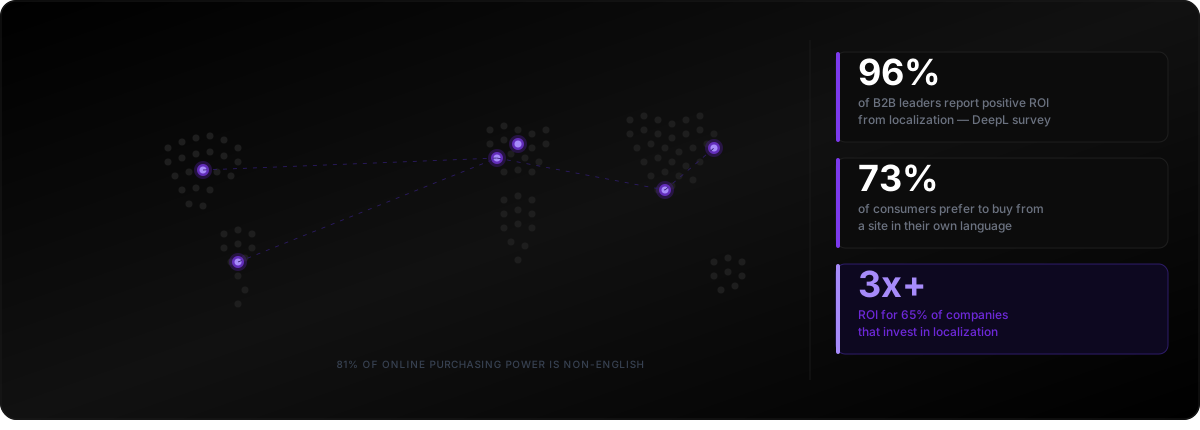
A DeepL survey of B2B leaders found that 96% reported positive ROI from localization efforts, and 65% reported an ROI of 3x or greater.
Shopify research shows that localized personalization leads to 10–15% higher conversion rates. A 10% lift in conversion across a market you already have traffic from costs nothing in acquisition — you're just converting visitors you were already paying to reach.
OneSky data shows localization increases search traffic by 47% and website visits by 70%. Multilingual SEO compounds over time in a way that paid acquisition doesn't.
Companies that have made the transition from single-language to multilingual have seen sales increase by at least 25%. Some have seen 70%.
The flip side: 37% of businesses say slow time-to-market is a major challenge when entering international markets. Every week of delay is a week competitors have to establish themselves in the language you're not in.
What silent risks compound when you skip localization?
Localization problems don't crash your app. They don't show up in error logs. They're silent failures — a German user who sees a button overflow its container and leaves, a Japanese user who encounters an untranslated error message and loses trust, a Brazilian user who can't complete checkout because the date format is wrong.
These aren't caught in QA. They accumulate as churn in markets you can't see clearly because you're not measuring them at a language level.
The longer you wait, the worse it gets — because every feature you ship adds more hardcoded strings to extract later. A codebase that takes three days to localize today will take three weeks in six months. The refactoring cost grows linearly with your feature count.
29% of localization professionals report missing deadlines as a recurring problem. The teams hitting that number are the ones who pushed localization to later and are now racing to catch up under deadline pressure.
Why did AI coding tools change localization timing without fixing sync?
Here's what changed in 2025 and 2026: AI coding tools made it possible to build apps without writing much code. Cursor, Copilot, Lovable, Bolt — a solo founder can now ship a full-stack SaaS in days.
That's genuinely good for builders. But those tools optimized for working UI, not global architecture. The output is functional, fast, and almost entirely hardcoded English.
So the addressable market for "apps that should be localized but aren't" has exploded. Thousands of vibe-coded SaaS products launch every week, get international users immediately — because the internet is global by default — and hit the same wall when someone asks for a second language.
The AI coding tools made building easier. They didn't solve continuous localization. And continuous localization is where it gets messy.
What breaks when teams treat continuous localization as quarterly batches?
"Just use AI translation" sounds reasonable until you're actually maintaining a multilingual product.
The problem isn't the first translation. It's everything after:
New strings ship constantly. Every feature you add is new UI text. If you're not running an automated sync, those strings don't get translated until someone notices — usually a user from that market, after it's already live.
Keys drift. Developers create submit, submitOrder, submit_order, and checkout.submitacross different components. Now you have four translations of the same concept that don't match. Users see inconsistent terminology.
File management becomes overhead. Teams get stuck shuttling locale bundles through chat, email, and ad hoc services, then merging brittle JSON by hand—this is the workflow that breaks under fast-moving products. Spreadsheets, lost attachments, and version conflicts follow.
Context collapses.AI translation without a glossary produces inconsistencies that compound over time. The word "checkout" gets translated differently in different strings. The word "account" appears as three different words in Spanish across your UI. Users notice even if your team doesn't.
This is why the localization industry built TMS tools — Lokalise, Crowdin, Phrase — with translation memory, glossaries, and workflow management. Those tools solve real problems. But they're designed for teams with dedicated localization managers, not for a two-person startup shipping two features a week.
What pattern works for a small team in 2026 without heavyweight coordination?
The teams solving this problem aren't running elaborate TMS workflows. They're automating the boring parts and staying out of the way.
The working pattern looks like this:
Architecture first, once. Run npx skills add globalize-now/globalize-skills, set up localization for your project, convert your existing strings. This is the hard part — but you only do it once. Your agent handles it.
Automatic sync on every push. Connect your repo. From that point forward, every new string you ship gets detected, translated with your glossary for consistency, and PRd back automatically. You don't think about it.
Trust the infrastructure. That's the whole point. Set it up once, then ship your product. globalize.now handles the localization in the background — no queue to manage, no files to export, no missed strings to chase down later.
This is what globalize.now is built around. The agent does the architecture work. The GitHub CI does the ongoing sync. You stay focused on the product.
The old argument for delaying localization was that it was too expensive and too time-consuming for an early-stage product. That argument is gone. The tooling now makes localization something you can do in an afternoon and maintain automatically from that point forward.
The question isn't whether to localize. It's whether to do it before or after you've built a mountain of technical debt.
Where should an early-stage team start this week?
If you're building something and you have any international users — or expect to — the answer is the same:
Set up i18n infrastructure now, even if you only ship one language for the first six months. The cost of doing it now is a few hours. The cost of doing it later is a week of refactoring, minimum.
If you've already launched and you're sitting on a codebase full of hardcoded strings: that's what globalize.now exists to fix. Your agent scans the codebase, extracts the strings, generates the keys, creates the locale files, and sets up the sync. What would take a week manually takes an afternoon.
The market is there. The data is clear. The tooling exists.
globalize.now is AI-powered localization infrastructure for developers. No manual refactoring. No missed strings. No i18n debt.
globalize.now turns hardcoded app copy into translation-ready locale files and keeps them updated as you ship.
Try globalize.now free