
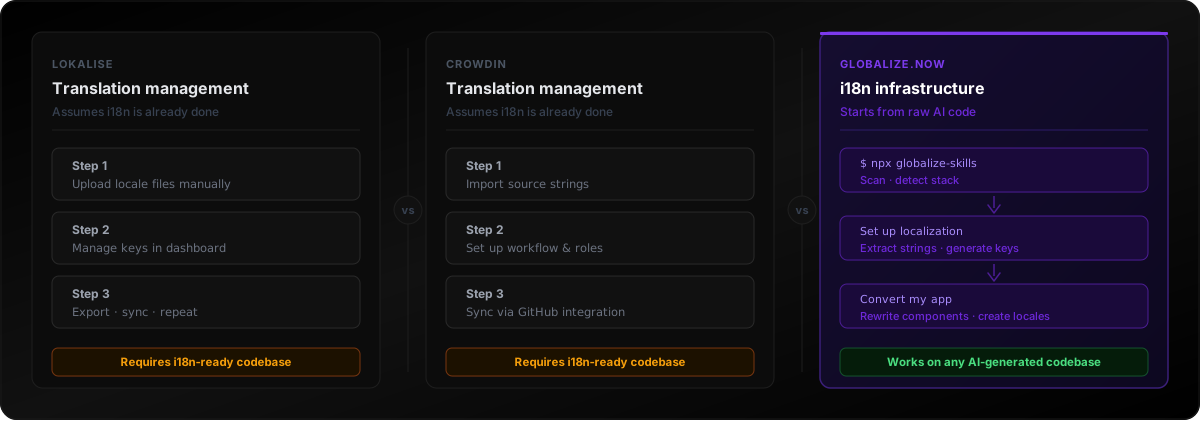
This article compares Lokalise, Crowdin, and globalize.now for teams shipping AI-assisted codebases. globalize.now is AI-powered localization infrastructure that automates extraction and locale sync on every Git push, while Lokalise and Crowdin coordinate human translation work once importable keys already exist. If your product already has translation keys, locale files, and a clean extraction pipeline, either coordination platform can be an excellent choice.
For dedicated comparison pages with feature matrices and FAQs, see globalize.now vs Lokalise and globalize.now vs Crowdin.
The friction shows up in a different scenario: AI-generated apps where the UI is still mostly hardcoded English. In that world, the bottleneck is rarely “we need a better coordination stack.” It is “we do not yet have an i18n layer for those tools to attach to.”
For a concrete audit of our own multilingual marketing site (including failures we shipped in German and French), read We ran globalize.now on globalize.now — here's what broke.
For the architecture gap itself, read AI Code Broke Localization — And Nobody Fixed It. For a practical path from raw components to locale files, see How to Localize an AI-Generated App.
What do Lokalise and Crowdin optimize for?
Both products are built around a similar contract: meaningful units of translatable text already exist as keys, segments, or files that can be imported, assigned, reviewed, and exported. Their strengths include collaboration, permissions, automation, integrations, and translation memory.
That model works beautifully when engineering has already done the unglamorous work: extracting UI strings, stabilizing identifiers, handling plurals and variables, and keeping the catalog aligned with production code.
Where do AI-generated codebases diverge from coordination-tool assumptions?
When a product is assembled quickly with AI assistance, teams often ship readable English UI first and defer i18n discipline. The result is predictable: duplicated labels, inconsistent phrasing, strings embedded in JSX, and no single source of truth for translators.
In that state, a TMS cannot magically infer which literals are user-visible, which are developer-only, or how to rewrite components safely. Without a bridge from repository reality to translation-ready keys, you end up with manual cleanup projects that compete with feature work.
What does globalize.now add before coordination tools help?
globalize.now is not a drop-in replacement for a TMS mindset. It is positioned earlier in the pipeline: scanning code, proposing keys, generating locale scaffolding, and refactoring UI to call into a real i18n API. Once that foundation exists, syncing translation-ready bundles to Lokalise, Crowdin, Phrase, or any other workflow tool becomes a normal integration problem again.
- Treats the repo as the source of truth for what users actually see.
- Focuses on eliminating the “missing i18n layer” instead of assuming it.
- Designed for teams shipping AI-assisted code who still need credible multilingual releases.
What does a blunt comparison table assume about each product class?
This table is intentionally blunt about assumptions — not about product quality. Lokalise and Crowdin are strong at what they are built to do.
| Question | Lokalise | Crowdin | globalize.now |
|---|---|---|---|
| Primary job-to-be-done | Manage translation workflows | Manage translation workflows | Build i18n-ready structure from real code |
| Typical starting artifact | Keys / files you import | Keys / files you import | The repository as it exists today |
| Assumes i18n-ready codebase | Yes (by design) | Yes (by design) | No — that is the problem it targets |
| Best when your team already has… | Stable keys + locale files + CI export path | Stable keys + locale files + CI export path | Hardcoded UI, partial i18n, or AI-generated sprawl |
| Sweet spot | Vendor coordination + review at scale | Community + engineering translation | Automated extraction + refactor toward coordination-ready output |
Which capability should you fund first on an AI-sprawl codebase?
If you already have a disciplined i18n setup and you need workflow, pick the coordination product that fits your team — Lokalise and Crowdin are both credible options in that phase.
If your app is AI-generated (or simply never had a real i18n layer), starting with translation coordination alone tends to push pain downstream. In that situation, the highest leverage move is to make the codebase translation-ready first, then plug in Lokalise, Crowdin, or any other system you prefer for collaboration and delivery.
That sequencing — code truth first, TMS second — is the distinction globalize.now is built around.
What is the bottom-line sequencing rule?
Lokalise and Crowdin coordinate translation work once segments exist. globalize.now automates the earlier step — turning AI-generated UI into structured, key-based, locale-backed code that stays synced on every Git push.
Curious how automation fits your repo? See the developers section for how globalize.now approaches real codebases.
globalize.now turns hardcoded app copy into translation-ready locale files and keeps them updated as you ship.
Try globalize.now free