
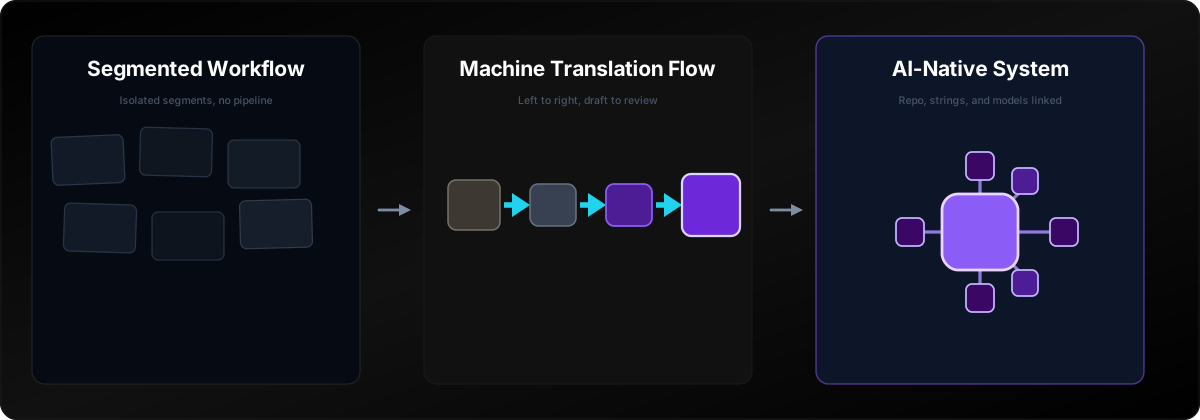
Localization didn't start with AI, It didn't even start with TMS's, It started decades ago with tools built for translators, not product teams. And that legacy still shapes how the industry operates today.
At globalize (globalize.now), we've spent years working inside the localization space—building platforms, working closely with customers, and seeing firsthand how the industry has evolved.
What's become clear is this: Localization doesn't evolve gradually. It shifts in waves.
We've already seen two major shifts. Now, a third is happening—and it's the most important one yet.
What was localization like in the CAT tool era?
Before modern localization platforms, the industry was dominated by CAT tools (Computer-Assisted Translation tools).
These tools introduced:
- Translation memory
- Terminology databases
- Structured workflows
They were a major step forward at the time, But they were built for a different world:
- Translators working in isolation
- Segment-based translation
- Limited connection to product development
Even today, parts of the industry are still anchored in this model and every shift since has been about moving away from these constraints.
What was Stage 1 — design-stage localization?
The first major shift came when localization moved earlier in the product lifecycle.
Traditionally, teams would:
- Build the product
- Extract strings
- Translate later
This created bottlenecks, inconsistencies, and constant rework.
While working closely with customers during the early days of modern localization platforms, one theme came up repeatedly:
We need localization to start earlier.
This led to the rise of design-stage localization, bringing localization directly into design workflows.
Teams began:
- Designing with multiple languages in mind
- Structuring content earlier
- Reducing downstream engineering work
Why this mattered:
- Faster global releases
- Less rework
- Better product consistency
Localization shifted from a post-process to a design consideration.
What changed in Stage 2 when machine translation went mainstream?
The second shift was driven by machine translation (MT).
Machine translation existed long before it became mainstream. In the early days, it was mainly used by early adopters, experimental teams, and die-hards willing to work with imperfect output.
Wider adoption didn't happen until two things changed:
- The rise of agile development as a standard working norm in localization, not waterfall.
- The shift toward design-stage localization
As teams began shipping faster and working in continuous cycles, the need for speed and scalability became critical.
This environment made machine translation not just useful, but essential.
A new model emerged:
- Machine translation generates the first draft
- Humans review and refine
Why this mattered:
- Massive increase in translation speed
- Lower cost of scaling globally
- Enabled continuous localization
Localization evolved from a manual process into a technology-augmented system.
What is Stage 3 — the AI-driven localization shift?
We're now entering the third stage, and it's fundamentally different.
AI isn't just improving localization. It's redefining it entirely and at the same time, a new generation of builders has emerged:
- Indie developers
- Startup founders
- AI-native teams
These builders are shipping products faster than ever but localization hasn't kept up.
Most developers today:
- Don't structure apps for multilingual support
- Don't create glossaries or style guides
- Don't think about localization until it becomes a problem
And the tools available were built for a previous era.
The Gap
There is now a growing gap between:
- How fast products are built
- How well they scale globally
That gap is where products fail to internationalize effectively.
The Shift to AI-Native Localization
This is where the next evolution begins.
Localization is no longer:
- A separate workflow
- A specialist function
- Something that happens later
It becomes:
- Automated
- Embedded into development
- Driven by AI from day one
How globalize Is Built for This Shift
At globalize (globalize.now), we're building specifically for this new reality.
Instead of forcing developers to learn localization, we:
- Connect directly to repositories
- Generate localization files from existing content
- Build glossaries and style guides automatically
- Integrate with AI workflows
All in a single, streamlined process.
Developers don't need to think about localization systems, they just build, and their product is ready to scale globally.
How is localization shifting from process to infrastructure?
Across these stages, localization has evolved:
Now it's becoming something else entirely, Localization as infrastructure, not process.
What is the real takeaway for teams shipping with AI?
AI isn't just accelerating localization.
It's exposing how broken the current model is.
Because the problem was never translation.
It was always the code.
Today, thousands of apps are being generated with AI — fast, functional, and completely unprepared for global users.
Hardcoded strings. No structure. No system.
And when those teams decide to expand, they don't start translating.
They start rewriting.
That's the shift.
Localization is no longer something you add.
It's something your codebase either supports — or fights.
If you are shipping UI from Cursor, Copilot, or similar tools, see how globalize.now keeps AI-built apps translation-ready.
For why hardcoded English collides with translation workflows, read how AI-generated code exposed the missing i18n layer.
The companies that win won't be the ones translating faster.
They'll be the ones whose products are global-ready by default.
Everyone else will hit the same wall:
"We need another language."
And realize they built something that can't scale.
globalize.now turns hardcoded app copy into translation-ready locale files and keeps them updated as you ship.
Try globalize.now free