
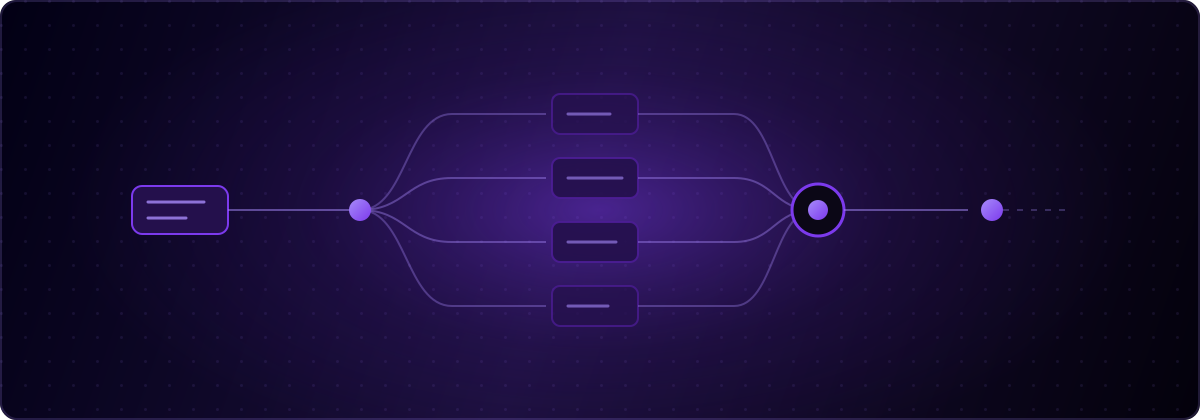
AI localization is the use of AI to run the entire localization workflow: extracting hardcoded strings from a codebase, generating translation keys and locale files, translating with context, and keeping every language current as the product changes. globalize.now is AI-powered localization infrastructure built on that definition, designed to run inside the coding agents developers already use. This guide covers what the term actually means, how it differs from machine translation, and what changed now that coding agents can do the work.
What is AI localization?
AI localization is workflow automation, not a smarter translation button. Translation itself was never the hard part of shipping a multilingual app. The hard part was everything around it: finding every user-facing string, structuring keys, managing a file per language, briefing translators on context, and repeating all of it every time the product changed.
The demand side has not moved: CSA Research's survey of 8,709 consumers across 29 countries found 76% prefer buying with information in their own language, and 40% will not buy in other languages at all. What moved is the cost side. The broader language industry sits around $72.6 billion a year and has gone nearly flat per Nimdzi's 2026 industry sizing, while the work itself migrates to software. AI localization is the name for that migration.
How is AI localization different from machine translation?
Machine translation produces target-language text from source text. That is one step, and engines like DeepL or an LLM handle it well. AI localization is the pipeline around that step: detection of translatable strings in code, key and locale-file generation, context assembly (what screen is this string on, what tone does this brand use), translation, pluralization handling, and sync back into the repository.
The distinction matters when you evaluate tools. A machine translation engine with a nice API still leaves you hand-managing extraction and files. A localization glossary refresher covers the underlying terms, but the short version: translation is a component, localization is the system.
What did AI localization look like inside traditional tools?
Incumbent localization platforms added AI as a feature inside an unchanged workflow. Lokalise, Crowdin, and Smartling all offer AI translation suggestions today, but the surrounding process still assumes a dashboard, a review queue, and a localization manager routing work between them. Pricing follows the same assumption: per seat, per language, per workflow tier.
That model fits companies with localization teams. It does not fit a two-person startup whose localization team is a coding agent and a Friday afternoon. Slator's 2026 market report sizes language AI solutions at roughly $30 billion and growing, and the growth is concentrated exactly where the old workflow assumptions break.
What changes when a coding agent does the localization?
The workflow moves into the repository and the agent, and the dashboard stops being the center. In an agent-native setup, a skill teaches your coding agent (Claude Code, Cursor, Codex, or Lovable) how to internationalize your codebase: it finds hardcoded strings, wires up the i18n library, and generates the locale files. From then on, every Git push triggers translation, and updated languages arrive as a pull request you review like any other code change.
Nothing new to log into. No export step, no import step, no copy-pasting strings into a web editor. The developer setup is one command, and non-developers building with AI tools get the same loop through their app builder. Review happens where engineers already review things: the diff.
How do you set up AI localization with a coding agent?
The full loop takes minutes on a typical app:
- Connect the repository at globalize.now. The conversion runs once, in the app. Prefer to stay in your editor? Install the skills instead:
npx skills add globalize-now/globalize-skills - Ask your agent to set up i18n. It inspects the repo, shows a plan, and waits for approval before touching code.
- Connect the repository to globalize.now so pushes trigger translation.
- Push. New and changed strings come back translated as a pull request.
- Merge. Your app ships in every configured language.
Step 2 is where AI localization earns the name: the agent handles the internationalization work that used to be a week of manual refactoring, and the infrastructure handles everything after.
Is the translation quality good enough for production?
For UI strings and product copy, yes, provided the system feeds the model context. Quality in practice comes from four things: a glossary that locks product names and terms of art, a style guide that sets register (formal Sie versus informal Du in German is the classic failure), correct ICU plural handling per language, and string-level context about where text appears. Generic machine translation fails on register and terminology, not on grammar.
The remaining role for humans is judgment on high-stakes surfaces. The practical difference from the old world is that human review now means reading a diff of real strings in a pull request, not working through a queue in a separate tool.
What should you look for in AI localization tooling?
Five checks separate agent-native infrastructure from AI features bolted onto old workflows. Does it run inside the coding agent you already use? Does it handle internationalization setup, not just translation of existing files? Does sync happen automatically on push, with changes arriving as pull requests? Can you control quality with glossaries and style guides? And is pricing transparent usage rather than seats and per-language fees?
If a tool fails the first three, you will still be doing the coordination work yourself. The coordination work was the whole problem.
globalize.now handles all of this. Set it up once and every push comes back translated.
globalize.now turns hardcoded app copy into translation-ready locale files and keeps them updated as you ship.
Try globalize.now free