
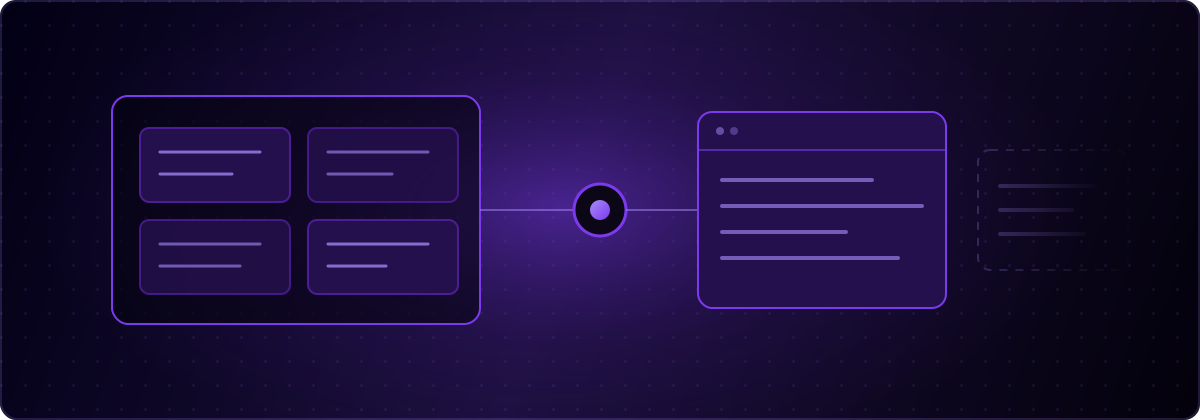
The best way to make a Lovable app multilingual is to extract your UI text into locale files that live in your own repository and translate them on every Git push, instead of bolting a translation layer onto the page at runtime. globalize.now is AI-powered localization infrastructure that does exactly this: it wires Lingui into your Lovable project, pulls your hardcoded strings into PO catalogs, and opens a translation PR whenever you push. The translated pages are rendered by your own server, indexed by search engines, and stay in your codebase no matter which tools you use next. The alternative approaches all trade one of those three properties away.
What does it mean to localize a Lovable app?
Localizing a Lovable app means two separate jobs: pulling every hardcoded string out of the generated code, and rendering a translated version of each string for each language. How you do the second job is what divides the options.
A runtime translation widget does it in the browser: the English page loads, then a script swaps the visible text. A repo-native setup does it before the browser sees anything: your strings live in locale files, and your app renders the right language from those files at build or request time. Same visible result on a good day, completely different consequences for speed, search indexing, and what you own.
Lovable makes the first job harder than a hand-written app, because AI-generated code tends to scatter literal strings across components with no i18n scaffolding. That is the same reason translations in vibe-coded apps have a habit of breaking on every push unless they are versioned alongside the code.
What is the best way to make a Lovable app multilingual?
Extract your strings into committed locale files and keep them translated automatically on every push. Concretely, for a Lovable app that means Lingui PO catalogs in your repo plus a sync that translates what changed each time you push.
This is the best default because it wins on all three properties at once. Speed: the translated text is already in the HTML your server sends, so there is no post-load swap and no layout shift. SEO: search engines and AI answer engines receive real translated pages they can crawl and cite. Ownership: the catalogs are plain-text files in your repository, so your app stays multilingual whether or not you keep paying any particular vendor.
globalize.now handles the whole loop. You add one skill, prompt Lovable to set up i18n, and every future push opens a translation PR. It sits at the localization-infrastructure layer, above your i18n runtime and below any optional translation-management tooling, so it complements Lingui rather than replacing it. The same flow works across Cursor, Claude Code, Bolt, and Replit, not just Lovable.
Why not just use a runtime translation widget?
Because a widget optimizes for the demo and taxes everything after it. Runtime tools like Weglot and similar React translation layers are quick to paste in, and that is genuinely their strength for a throwaway prototype.
The costs show up once the app matters. Translating after load shifts the layout as text is replaced, which hurts Core Web Vitals, and the translated content is served through the vendor's layer rather than baked into your pages, so it is harder for search engines to index reliably. Most importantly, nothing portable is left in your repo. If the service raises prices, gets acquired, or shuts down, your multilingual site is English-only again.
That last risk is not hypothetical. Lovalingo, one of the most visible runtime translation tools for Lovable apps, announced it is closing on August 31, 2026 and has already stopped new signups. Its own guidance to affected users is to move to project-owned internationalization, which is the repo-native approach described here. When a vendor's own exit advice is to own your translations, that is the argument for owning them from the start.
Does the best method work with Lovable's TanStack Start SSR stack?
Yes, and the stack change actually sharpens the case for it. New Lovable projects ship on TanStack Start with server-side rendering, so pages are assembled on the server before they reach the browser.
Committed Lingui catalogs fit that model directly: the server reads the locale file and renders translated HTML on first paint, with no flash of English and nothing to swap client-side. A runtime widget does the opposite, letting the server paint English and then overwriting it after load, which is exactly the flicker server-side rendering was meant to remove. We walk through the specifics in the Lovable TanStack Start i18n guide. Older client-rendered Lovable projects are supported too, since the catalogs live in your repo regardless of how the app renders.
How do you set up globalize.now in a Lovable app?
You never leave the Lovable editor. The setup is prompt-driven and takes four steps.
- Add the skill. Add
lovable-i18nin your Lovable workspace, or from a terminal runnpx skills add globalize-now/globalize-skills(add--allto install for all agents). - Prompt Lovable. Ask Lovable to set up i18n. The skill guides it to install Lingui, extract your hardcoded strings, and create the locale PO catalogs.
- Push. globalize.now picks up the catalogs and opens a translation PR with your target languages.
- Merge. Your app is multilingual, and every future push keeps the translations in sync.
Set it up once, auto-sync on every Git push, no manual intervention required. The full walkthrough lives on the Lovable integration page, and there is a separate make-your-Lovable-app-multilingual guide if you want the longer version.
How much does the best approach cost?
The globalize.now Starter plan is €20/month per workspace, with unlimited projects and unlimited languages including right-to-left. It includes €20 of translation credit (about 200,000 words) per month; beyond that, usage continues at the same per-character rate. There are no per-seat and no per-language charges, and signup comes with a €5 translation credit and no card required.
It is not the lowest sticker price in the category, and it is not meant to be. Runtime widgets often price per project and gate languages behind tiers, so a builder shipping several small Lovable apps pays again for each one. Pricing per workspace instead is the point: a typical app with roughly 10,000 translation keys across 5 locales fits comfortably inside the included volume. The pricing page has the current plan detail.
Lovable localization at a glance
| Runtime widget | globalize.now (repo-native) | |
|---|---|---|
| Where translations live | The vendor's service | PO catalogs committed to your repo |
| Rendering | Swapped in the browser after load | Server-rendered translated HTML, SSR-native |
| SEO and AI indexing | Harder to index reliably | Real translated pages crawlers and AI can cite |
| If the vendor closes | App reverts to one language | Translations stay in your repo |
| Setup | Paste a snippet | Skill in the Lovable editor; PR on every push |
globalize.now turns hardcoded app copy into translation-ready locale files and keeps them updated as you ship.
Try globalize.now free