
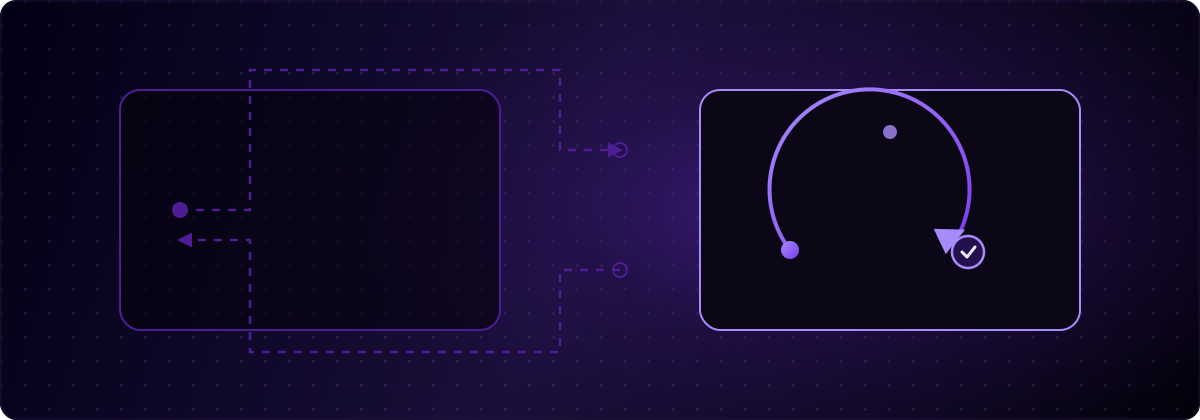
Localization is moving upstream because the old pipeline's core assumption broke: that code changes slowly enough to export a stable string catalog, translate it elsewhere, and import the results before the next release. AI coding agents killed that assumption. globalize.now is AI-powered localization infrastructure built for the new position: localization that runs inside the development loop and ships as a pull request. This essay is about why position, not translation quality, is the thing that changed.
What does it mean to move localization upstream?
It means the unit of localization work stops being a string catalog and becomes a commit. In the old model, localization starts after the code is done. In the upstream model, it happens where the code lives, at the moment the code changes, and its output is code: a localized PR you diff, review, and merge.
The two pipelines look like this.
Traditional:   build → internationalize → export → translate → review → import → ship

Upstream:      code → push → localized PR → merge → ship
The first pipeline has seven stages and leaves the repository twice. The second has five, and none of them leave the repo. That structural difference, not any single feature, is what this essay is about.
How does the traditional localization pipeline work?
It works as a round-trip, and every arrow in it is a queue. You build the feature. You internationalize it, extracting strings into keys, assuming your team or your AI agent produced structured code in the first place. You export the catalog to a translation platform. Translators or machine translation process it. Someone reviews. You import the results, resolve the conflicts that accumulated while the catalog was out, and ship.
Each handoff exists because the work happens in a different place, owned by different people, on a different clock. That was a reasonable design when releases were quarterly and strings changed in batches. The pipeline's hidden dependency is stability: the catalog must hold still long enough to make the round-trip.
It no longer holds still. In the DORA 2025 State of AI-Assisted Software Development report, 90% of software professionals reported using AI tools at work, and DX's Q4 2025 impact study measured AI-authored code at 22% of merged code at the median company it tracked. Code that used to change weekly now changes between lunch and the standup.
What does localization look like inside the dev loop?
Like any other automated check that runs on push. You convert the codebase once: strings extracted, keys generated, locale files created, runtime wiring in place. After that, sync runs on push. When a commit introduces new strings, the translations come back as a pull request against your branch, in your repository, structured the way the rest of the app is structured.
This is not hypothetical throughput. In a run we recorded in August 2026 on a demo repo, a pushed commit came back as a localized PR covering 30 translation units across German, French, and Spanish in 49 seconds. Under a minute, commit to reviewable PR, with no human in the loop until review. Compare that with any pipeline that includes the word "export."
The one-time conversion, to be clear, is not instant. On real apps it takes around 30 minutes, because it is restructuring code: extracting strings, generating keys, wiring a runtime. That is the door. The loop on every push afterward is the product.
The important property of that loop is not the speed. It is that nothing left the repo. There is no catalog sitting in an external platform slowly diverging from main. The monorepo run we published earlier showed the one-time conversion at scale; the loop is what keeps the result alive afterward. Merge or close, the same two verbs that govern every other change. If you work this way already, the developer docs show the setup.
Why do AI coding agents force this change?
Because they moved the bottleneck. The constraint in localization used to be translation capacity: how fast a vendor or an engine could process a well-structured catalog. Agents generate well past that constraint and created a new one, upstream of it. The scarce resource now is architectural sanity after generation, keeping keys consistent, locale files complete, and structure intact while an agent adds UI to the codebase daily.
An agent asked for a checkout page produces a working checkout page with the strings hardcoded into the JSX. We wrote about the anatomy of this in AI code broke localization: one analyzed React project carried 1,284 UI strings across 312 files with zero i18n structure. The catalog the traditional pipeline wants to export does not exist in that codebase. And the codebase will look different again tomorrow, because the agent keeps shipping.
A downstream pipeline meets that reality permanently behind. Whatever it exported is stale by import time. The only position from which localization can keep up with generated code is inside the loop that generates it, and that holds whether the code comes from Cursor, Claude Code, or Lovable.
Isn't AI translation the same thing?
No, and this is where the market conversation goes wrong. Lokalise describes itself as an AI localization platform; Phrase ships Language AI for machine translation at scale. Both are real capabilities. Both make one arrow in the old pipeline faster: the translate step. The catalog still gets exported, still lives in an external platform, still comes back through an import.
A faster arrow in a seven-stage round-trip is an optimization. Removing the round-trip is a different product. That is the actual layer distinction: platforms built around translator workflows occupy the management layer, and globalize.now occupies the infrastructure layer below it, generating the keys and locale files from the code itself, in the repo. "AI-powered" describes both. It distinguishes neither. Position does.
What still belongs downstream?
Human judgment on high-stakes copy. Legal text, regulated claims, brand voice in a market you care deeply about: these deserve a professional translator and a review pass, and teams with that need will keep tools built around translator workflows. Nothing about upstream localization prevents that; the localized PR is a reviewable surface, and a human can hold it to any standard before merge.
What ends is the era when every team had to adopt a translator-workflow platform just to ship a second language. A solo developer with an AI-built product does not have translators to manage. They have commits. The tooling should meet them there.
The loop is the product
If your code ships through pull requests, your translations should too. globalize.now converts the codebase once, then keeps it localized on every push, PR in, PR merged, shipped.
globalize.now turns hardcoded app copy into translation-ready locale files and keeps them updated as you ship.
Try globalize.now free